 By Soumya Ranjan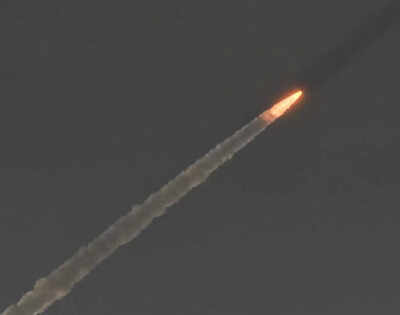
The rocket failed to reach its intended 524-km sun-synchronous orbit after deviating from its course during the PS3 phase, which began at 5:59 a.m. from the Satish Dhawan Space Centre.
In Short
* According to preliminary telemetry data, the third-stage motor did not function
* During the live stream, Isro Chief V Narayanan verified the problem.
* Because it was ISRO’s 101st launch, the PSLV-C61 mission held particular significance.
An anomaly in the third-stage propulsion system caused the EOS-09 Earth observation satellite launch to fail early Sunday morning, causing a rare setback for India’s Polar Satellite Launch Vehicle (PSLV-C61) mission.
Isro had to cancel the mission after the rocket, which had taken off from Sriharikota’s Satish Dhawan Space Centre at 5:59 a.m. IST, went off course during the PS3 solid rocket motor phase.
The 1,696 kg EOS-09 satellite, which was intended to provide C-band Synthetic Aperture Radar (SAR) imaging in all weather conditions, was unable to reach its intended 524 km sun-synchronous polar orbit.
The third-stage motor, which uses hydroxyl-terminated polybutadiene (HTPB) propellant, underperformed 203 seconds into the flight, according to early telemetry data. This is the first complete failure of the PSLV program since 2017 and the third in 63 launches.
Shortly after the launch, Isro Chief V Narayanan acknowledged the problem during the live stream.
To ascertain whether the problem was caused by structural failures, nozzle anomalies, or irregular propellant flow, engineers are analyzing flight data. To examine the manufacturing records and test procedures for the PS3 stage, a failure analysis committee has been established.
The setback delays India’s plans to enhance border surveillance and disaster response capabilities through SAR imaging.
The PSLV-C61 mission was particularly significant because it was ISRO’s 101st launch after 58 successful launches since 2017.
Debris will fall safely, but the rocket’s fourth stage and satellite were destroyed by flight termination procedures.
India’s ambitious 52-satellite surveillance constellation program has been temporarily put on hold due to this incident, but ISRO says four more PSLV launches are still planned for 2025.
The space agency has a history of recovering quickly from setbacks; in the past, turnaround times have been less than six months.